
mechanics.hansenexus.dev — docs, and a live coverage report.


Behaviour specs with a coverage ratchet.
Every user-observable behaviour is one markdown file with labelled acceptance criteria. A committed manifest is compiled from them and gated against drift in CI. Every surface the project ships — route, endpoint, CLI command, scheduled job, whatever your adapters declare — must be claimed by a behaviour or explicitly ignored; anything else is a gap the build can be made to fail on.
The question it answers is "did we keep every behaviour?" during a rewrite or a redesign, and the reason it works is that the answer is checkable rather than asserted.
mechanics scan                     # every repo here, its stack, whether it is onboarded
mechanics init                     # set a repo up: config, corpus skeleton, CI, MCP
mechanics check --all              # corpus + waves + coverage
mechanics build --all --check      # drift gate
mechanics coverage --app=<slug>    # the table, the gaps, wave rollups
mechanics gaps --app=<slug>        # what is missing, split into fix / ask
mechanics report --html            # one self-contained page
mechanics mcp                      # serve the corpus to an agent over stdio
mechanics agents                   # which agent providers are reachable from here
mechanics run list                 # the docket/1 board
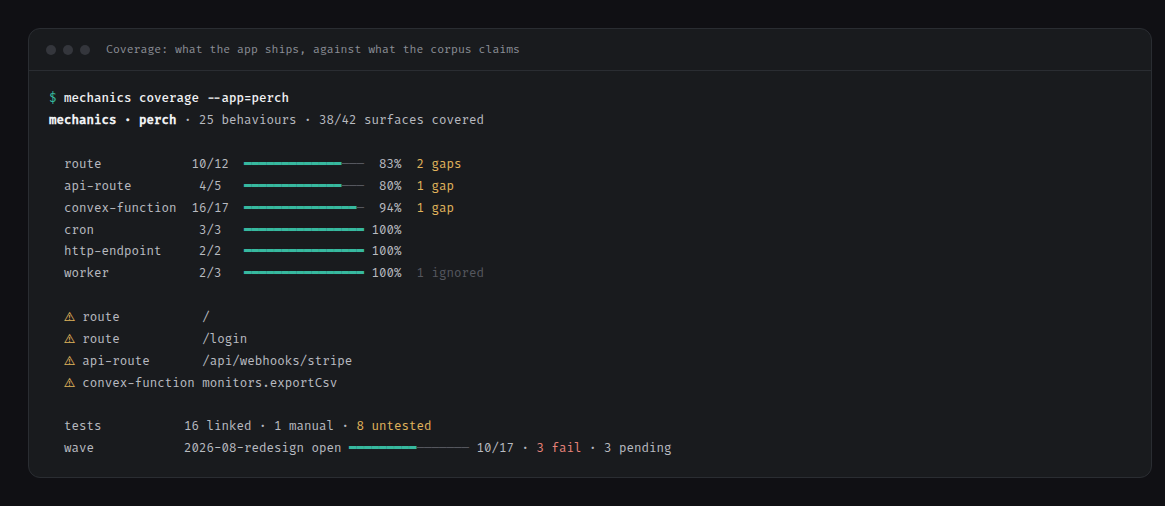
mechanics tui # leave it open: drift, gaps, runs, updatesCoverage is the whole idea: every surface the app ships, against every surface the corpus claims. What is left over is a gap with a name.
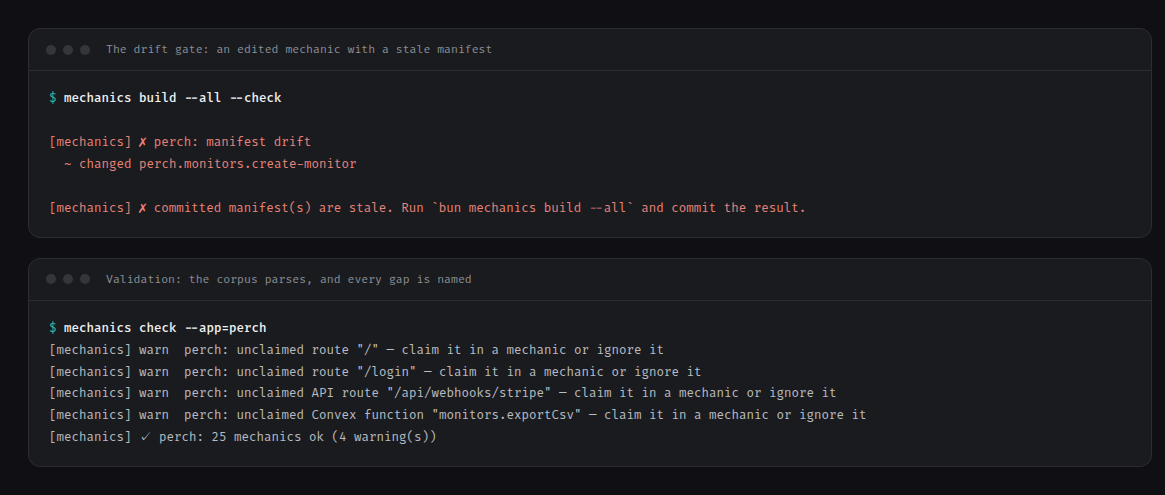
The gate is what stops the corpus rotting. Edit a mechanic without rebuilding the manifest and CI says so; validation names every gap rather than totalling them.
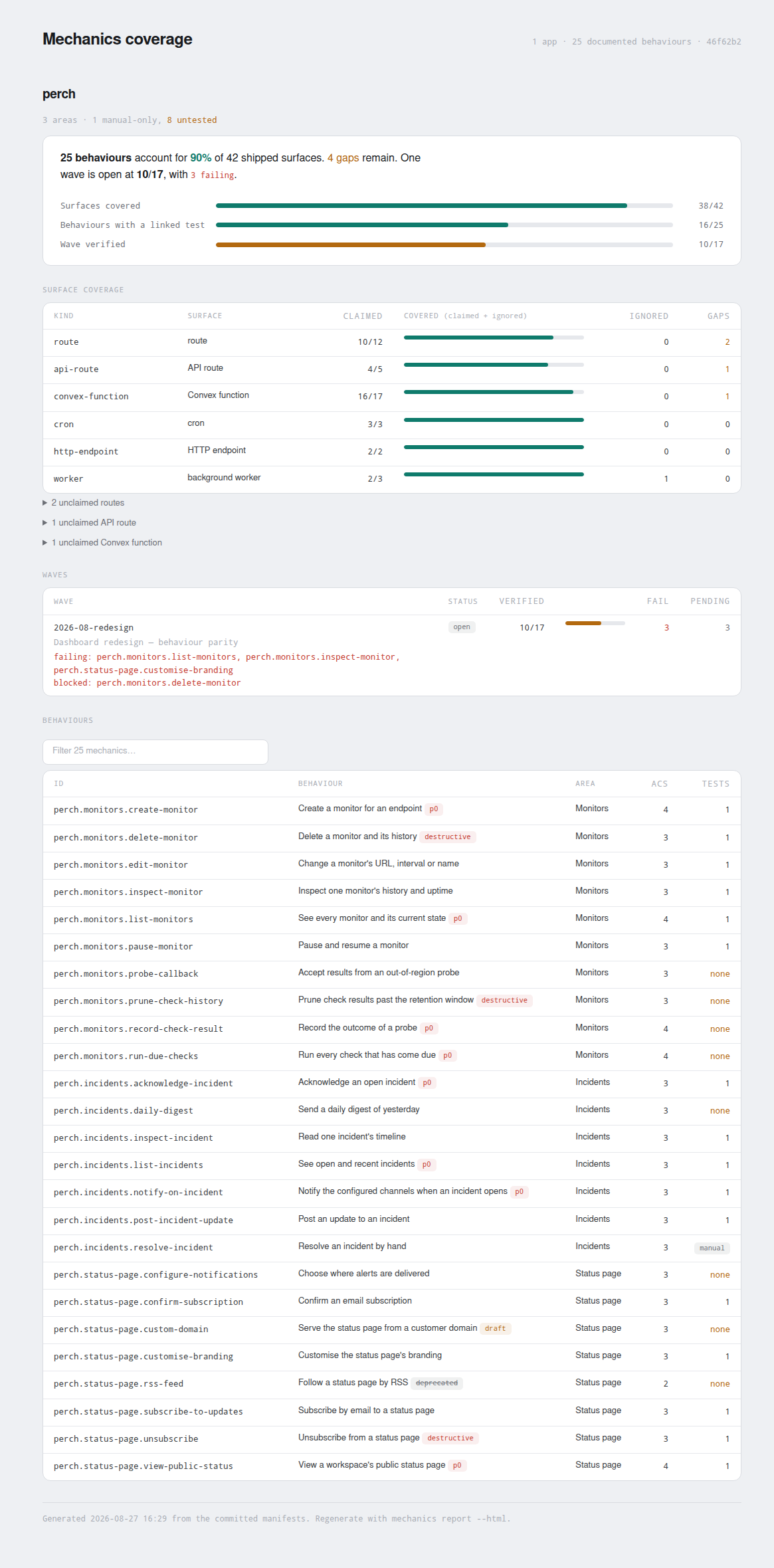
mechanics report --html is the same data as one self-contained page — no
build step, no server, no external request. Attach it to a PR, or open it from
file:// six months later.
Every one of those is generated from examples/perch by
bun run docs:shots, so they are the real CLI's real output on a real corpus.
The pipeline — scan, gaps, propose, fix — runs on whatever this machine
actually has. mechanics agents probes and says which:
mechanics agents                                   # what is reachable
mechanics gaps --app=<slug> --agent=claude         # a harness edits the tree itself
mechanics gaps --app=<slug> --agent=ollama --model=qwen2.5-coder:7b
mechanics gaps --app=<slug> --agent=?              # pick from what responded
Two provider shapes. A harness — claude, codex, qwen — is already an
agent: hand it a brief in a worktree and it edits with its own tools. A
model — ollama, lmstudio, any OpenAI-compatible endpoint — is text in,
text out and cannot open a file, so it answers in a small edit protocol that
mechanics validates, applies, and rolls back as one unit if the result does not
build. The protocol is exact-substring rather than a diff on purpose: a patch
needs the model to count context lines, and a hunk that lands at the wrong
offset still parses.
A provider may write mechanics, write specs, restructure app code — full reach
over the tree. Four moves are refused whatever the provider: editing a wave
file, promoting a draft to active, touching coverage.ignore, and flipping
coverage.enforce. Those are not work, they are claims that the work is good.
mechanics tuiA dashboard rather than a command: apps and their gaps, the issues worth acting
on ordered by how quietly they fail, runs in flight, proposals waiting on you,
and whether a newer release is out. It watches the corpus and .docket/, so it
reacts to an edit rather than to a refresh.
It never writes. The manifest is diffed with check, and the fix and scan keys
print the command instead of running it — a keystroke that mutates the repo
behind a full-screen redraw leaves you no diff and nowhere for the output to
go.
mechanics scan inventories the checkouts under a directory and says which
could be onboarded — stack, detected adapters, monorepo layout, and whether a
config is already there. It collapses linked worktrees into their primary
checkout, which is the difference between an honest count and a list that
reports one monorepo eleven times.
mechanics scan --root=~/repos              # the inventory
mechanics scan --adopt=<repo>              # what init would write — nothing yet
mechanics scan --adopt=<repo> --yes        # write it
There is no adopt-all, and no prompt: naming the repo is half the confirmation
and --yes is the other half, so the command behaves the same in a script as
in a terminal.
npm i -D @hansenexus/mechanics && npx mechanics init      # single-app repo
npx mechanics init --app=<slug>                           # monorepo: apps/<slug>
Init is idempotent (every file is skip-if-exists) and writes the repo config,
a corpus skeleton, the CI gate matched to your package manager and detected
adapters, the .mcp.json registration, the .docket/ directory, and the
committed manifest. --dry-run shows the plan; --no-ci, --no-mcp,
--no-docket opt out. Then replace the starter mechanic with real behaviours —
mechanics scaffold --app=<slug> drafts a stub per unclaimed surface.
Two worked examples ship with the package, and they show opposite ends of a corpus's life:
template/— whatinitgives you, and the starting point for a fork: small, fully claimed, green. It ships no routes and no Convex functions on purpose, sogeneric-globcarries the whole inventory and nothing works by accident of the built-in adapters.examples/perch— a corpus part-way through its life: 25 behaviours over three areas, both built-in adapters plus a glob-declared kind, four deliberately unclaimed surfaces, and a redesign wave in flight with failures and a blocker on it. It is what the screenshots above are pictures of, and a test asserts its gaps stay exactly the four it means to have.
| Core | parser, schema, manifest, coverage, waves, verify, CLI |
| Adapters | nextjs-app-router, convex, generic-glob — plus the SurfaceAdapter seam, so a stack nobody wrote an adapter for declares its surfaces in config instead of forking |
| MCP | six read tools over stdio: list, get, coverage, wave status, diff impact, decisions |
| Report | --html: one file, no build step, no external request |
| TUI | mechanics tui — the always-open view: drift, issues, runs, proposals, updates |
| Agents | claude, codex, qwen, ollama, lmstudio — harnesses edit directly, models edit through a validated protocol |
| Gaps | the five gap classes as predicates, each tagged auto (one correct answer) or propose (a judgment) — gaps --fix applies the first kind and refuses the rest in code |
| Decisions | .docket/decisions/ — ADRs retrievable by the file you are about to touch; an accepted record whose affects.paths matches nothing fails check, and two open runs deciding about one subsystem get flagged |
| docket/1 | the run protocol — work orders with checkable exit criteria and an append-only event log, with executable conformance vectors |
| Plugin | three Claude Code skills: init, verify, gaps |
Record a verdict without evidence. pass requires an evidence string, at
write time and again at read time. A hand-edited log cannot slip one through.
Let a model mark its own work green. The MCP server is read-only, and a
test asserts no write-shaped tool name is advertised. Verdicts go through
mechanics verify, which runs the specs, or verify --set, which is a
deliberate human action. The same line runs through the agent loop: an agent
may fix what has one correct answer, and may raise or reject a proposal, but
mechanics run accept refuses any actor that is not human — accepting asserts
a suggestion was right, which is the same act as marking work green. Both of
those refusals are the whole value of the format; a convenient way around them
would be a way of destroying it.
Stated plainly, because the alternative is overclaiming: the actor check
infers human from the absence of an agent session variable, so a process that
unsets it is indistinguishable from a person. It removes the default path and
nothing more. The durable boundary is that proposals and their resolutions are
committed files somebody reviews.
The mechanics bin is a bundled Node build (dist/cli.js), so both
npx mechanics and bunx mechanics work with no Bun requirement at use time.
The package also ships its TypeScript source, importable directly under Bun
(≥ 1.2), which is what development and the test suite run on.
Releases are published from CI over npm
Trusted Publishing, so the tarball on npm carries a signed attestation tying it
to this repository and the commit it was built from. repository in a
package.json is a claim anyone can make; the attestation is the part that can
be checked. There is no publish token to leak or rotate — npm verifies the
workflow's OIDC identity directly.
MIT. The protocol specification in spec/ is additionally available under
CC BY 4.0, so another implementation may reuse its wording with attribution.
See LICENSE.